
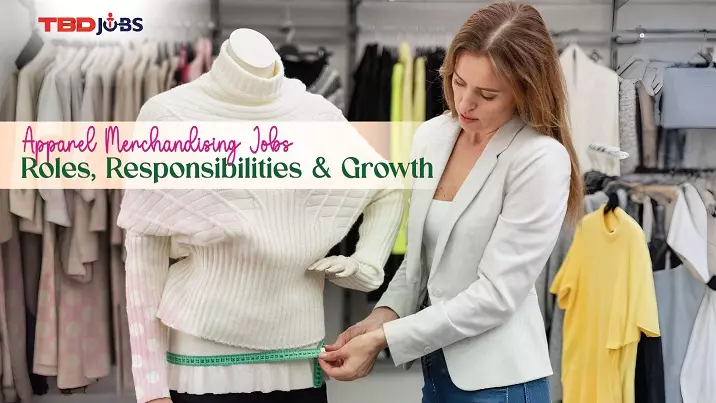
An apparel merchandiser is the backbone of the fashion supply chain, who handles the complete process from designing to finished product to meet the mass market demand. For professionals who want to build their careers as apparel merchandisers, they must create a strong resume with the required skills. It serves as the first point of interaction between recruiters and potential candidates.
For this job role, thousands of seekers are exploring multiple portals, including TBD Jobs, every week or month; well-defined job objectives and role clarity can be helpful to get placed easily.
If you are confused about what an apparel merchandising job truly involves, this will guide you through the roles, responsibilities, required skills, and career growth opportunities in apparel merchandising.
Also Read:- Apparel Industry Jobs & Career – Complete 2025 Guide
What Is Apparel Merchandising?
An apparel merchandiser refers to the comprehensive planning, development, and presentation of a product line from its original concept to its final form. In the fashion value chain, it plays a crucial role in striking a balance between manufacturing capacity (what the factory can produce) and market demand (what the customer wants).
In General, There are Two Primary Categories of Apparel Merchandising:
-
Manufacturing/Export Merchandising: Handle foreign brands’ production and shipments.
-
Retail/Brand Merchandising: Make a complete product line and plans for retail channels
Types of Merchandising
Types of merchandisers required in different areas of the supply chain:
-
Fashion merchandising: Required for buying raw material, assortment planning, brand strategy, and market trends.
-
Retail merchandising is looking into shelf-life management, pricing, in-store execution, and product placement optimisation.
-
Export merchandising oversees order execution, compliance, and shipment logistics while managing the complete production process for foreign buyers.
-
Visual merchandising makes plans, presentations, advertisements, and strategies to attract clients and increase sales.
Key Roles in Apparel Merchandising
The wide range of duties in the industry leads to distinct apparel merchandiser positions.
Fashion Merchandiser
The fashion merchandiser role concentrates on the "what" and "quantity" aspects of the product range. Their main duties involve analysing trends, designing product lines grounded in market research, determining pricing, and overseeing the budget for the collection (the fashion buying role).
Production Merchandiser
Commonly referred to as the Garment Merchandiser Career, this position serves as the connection between the buyer/design team and the manufacturing unit. The production merchandiser manages the elements, such as sampling, fitting validations, sourcing materials, and guaranteeing timely delivery. They hold a responsibility in managing the schedule of the entire garment production process.
Retail Merchandiser
The retail merchandiser oversees the product after it arrives at the store or online platform. They evaluate sales figures, adjust inventory quantities, handle discounts, and guarantee the correct product is stocked in the right place to enhance sales performance in apparel retail roles.
Visual Merchandiser
Visual merchandisers communicate the brand’s identity through physical and digital displays. Their work includes designing store layouts, window displays, and mannequin styling to highlight key collections and improve customer engagement.
Responsibilities of an Apparel Merchandiser
A merchandiser role is broadly divided into three parts, each aligned with a structured Time and Action (T&A) calendar: The three main groups are:
Pre-Production Responsibilities
This stage focuses on planning, preparation, and cost control:
-
Sampling: Coordinating proto samples, fit samples, and salesman samples, and securing buyer approvals.
-
Costing: Preparing detailed cost sheets (FOB, Ex-Factory, CMT) and negotiating prices with buyers and vendors.
-
Vendor Selection & Sourcing: Identifying and evaluating factories, fabric mills, and trim suppliers based on compliance, capacity, and cost efficiency.
During Production
Once an order is confirmed, the focus shifts to execution and quality assurance:
-
T&A Tracking: Monitoring the production timeline and ensuring all critical processes are completed on schedule.
-
Quality Control (QC): Coordinating internal and third-party inspections at different stages of production.
-
Buyer Coordination: Providing regular production updates and resolving issues related to delays or quality concerns.
Post-Production Responsibilities
The final phase ensures smooth order closure and shipment execution:
-
Dispatch Coordination: Managing shipping schedules, customs documentation, and timely dispatch of goods.
-
Inventory Tracking: Verifying final production quantities against confirmed orders.
-
Client Feedback: Collecting buyer feedback to improve future orders and strengthen long-term relationships.
Skills Required for Apparel Merchandising
Here is the list of skills required as a merchandiser:
Technical Skills
-
Product Costing: You must know how to break down and build up a garment's cost.
-
Excel Skills: You should be good at using spreadsheets to report and analyse data and create T&A calendars.
-
T&A Management: You need to know how to use planning tools or PLM (Product Lifecycle Management) software.
-
Fabric & Garment Knowledge: You should understand fiber properties, production machines, and quality standards.
Communication & Negotiation
-
Talking to Buyers: You must communicate with clients from home and abroad.
-
Team Coordination: You need to tell internal teams (Design, QC Factory) what to do and when to do it.
-
Dealing with Vendors: You should know how to get the best prices, payment terms, and delivery times from suppliers.
Educational Qualifications
Experience matters most, but formal schooling lays the groundwork:
-
Degrees: B.Sc. or B.Tech. in Fashion Technology, Textile Engineering, Fashion Design, or Apparel Merchandising programs.
-
Post-Graduate: MBA in Retail Management, Fashion Management, or Supply Chain Management.
-
Certifications: Special diplomas in fashion merchandising courses and quality management.
Career Growth Path in Apparel Merchandising
A step-by-step career path in apparel merchandising, which offers a chance to grow in this job profile. Here's what a typical career in apparel merchandising looks like:
-
Intern/Trainee
-
Assistant Merchandiser (1-3 years)
-
Merchandiser (3-6 years)
-
Senior Merchandiser / Merchandising Manager (6-10 years)
-
Category Manager / Buying Manager (10+ years)
-
General Manager / Head of Merchandising
How to Become a Senior Merchandiser?
To get promoted as a senior merchandiser, you need to do well in three main areas: ensuring shipments are on time, finding ways to cut costs and increase profits, and keeping buyers happy with your work.
Also Read: Clothing Designer Careers: Roles, Skills & Salary Guide
Salary Insights in Apparel Merchandising
Apparel merchandiser salary varies significantly based on experience, company size (buying house vs. large retailer), and geography.
| Role | India (INR/Year) | UAE (AED/Year) | USA (USD/Year) |
| Assistant Merchandiser | Rs 3,00,000 – Rs 5,50,000 | AED 60,000 – 90,000 | $45,000 – $60,000 |
| Merchandiser | Rs 6,00,000 – Rs 10,00,000 | AED 90,000 – 1,40,000 | $60,000 – $85,000 |
| Senior Merchandiser | Rs 10,00,000 – Rs 18,00,000+ | AED 1,40,000 – 2,50,000+ | $85,000 – $130,000+ |
Top Companies Hiring Apparel Merchandisers
-
Buying Houses/Export: Shahi Exports, Gokaldas Exports, Orient Craft, Li & Fung.
-
Domestic Brands/Retail: H&M, Zara (Inditex), Aditya Birla Fashion Retail, Reliance Retail, Raymond.
Apparel Merchandising vs Fashion Merchandising
| Feature | Apparel Merchandising (Production/Export) | Fashion Merchandising (Retail/Brand) |
| Primary Focus | Order execution, production management, costing, logistics, and factory compliance. | Trend analysis, product assortment planning, buying budgets, and in-store placement. |
| Work Environment | Factory floor, buying office, supplier meetings. | Brand HQ, retail stores, showrooms, trade shows. |
| Key Metric | On-time delivery, cost control, and quality adherence. | Sales velocity, profit margin, inventory turnover, stock-out rate. |
Apparel Merchandising Challenges
Merchandising can be both rewarding and difficult. Challenges for apparel merchandising include:
-
Meeting Tight Deadlines: With tight Time & Action (T&A) calendars and frequent changes from buyers.
-
Managing Quality Expectations: Between what factories can produce and the quality that buyers expect.
-
Managing Margins: Protecting Profit Margins While Purchasing Materials at Higher Costs.
Also Read: Fashion Merchandising in India: Role, Salary, Skills & Career Growth
Apparel Merchandising Future
The future of merchandising will be shaped by digitalisation, sustainability, and AI-driven decision-making:
Digitalisation:
The widespread implementation of Product Lifecycle Management (PLM) and Enterprise Resource Planning (ERP) systems enables a seamless flow of information through all aspects of product development (design, development, sourcing, etc.) and manufacturing (production planning).
Sustainability:
As a result of consumer trends toward ethically sourced products and increased awareness of the environmental impact of the fashion industry, merchandisers are being expected to take greater responsibility for sourcing materials, tracking their origin, and obtaining compliance certifications.
Artificial Intelligence (AI):
Using AI and machine learning to predict demand for products more accurately, optimise inventory levels, and build predictive pricing models.
Conclusion
Apparel merchandising offers a dynamic career path, blending creative product development with sharp commercial strategy. As the industry continues to evolve towards speed, sustainability, and digitalisation, the role of the merchandiser will only become more strategic and critical.
For professionals seeking continuous growth, competitive compensation, and leadership opportunities, apparel merchandising remains a highly rewarding career path.
To explore the latest apparel merchandising jobs, visit TBD Jobs—a dedicated fashion and apparel job portal connecting skilled professionals with leading garment manufacturers, buying houses, and global brands.
Also Read:- Apparel Jobs in 2025: Where Fashion Meets Opportunity



.webp)




Leave a Comment
8 Comments
30 Dec 2025, 04:16 PM
04 Jan 2026, 08:57 AM
14 Jan 2026, 02:15 PM
28 Jan 2026, 11:09 PM
12 Feb 2026, 12:27 AM
26 Feb 2026, 12:34 PM
14 Mar 2026, 07:58 AM
28 Mar 2026, 12:16 AM